
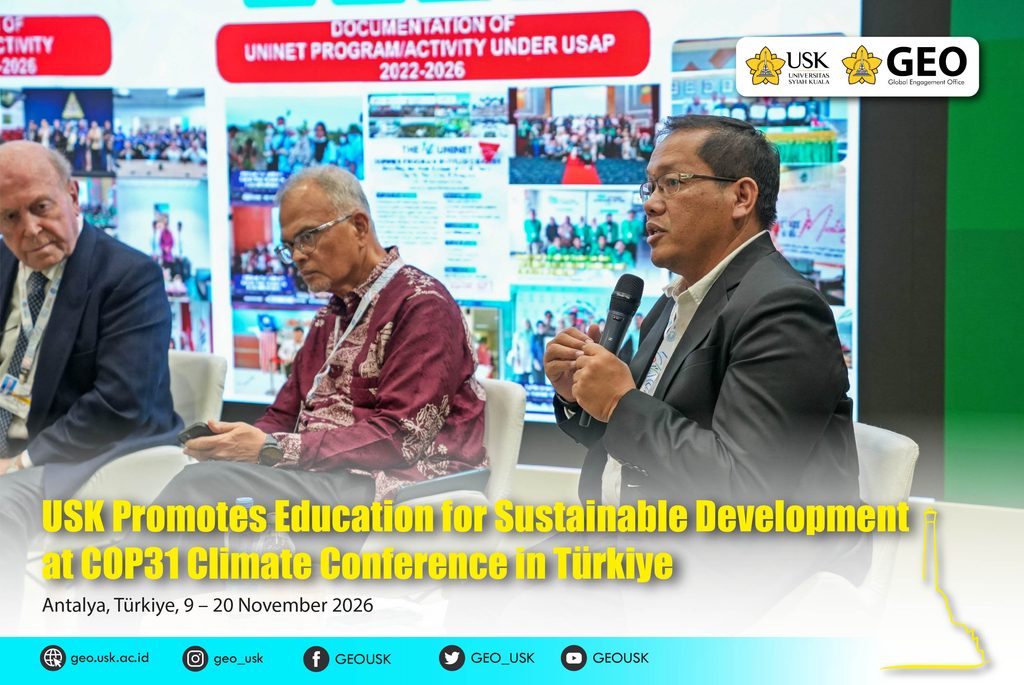
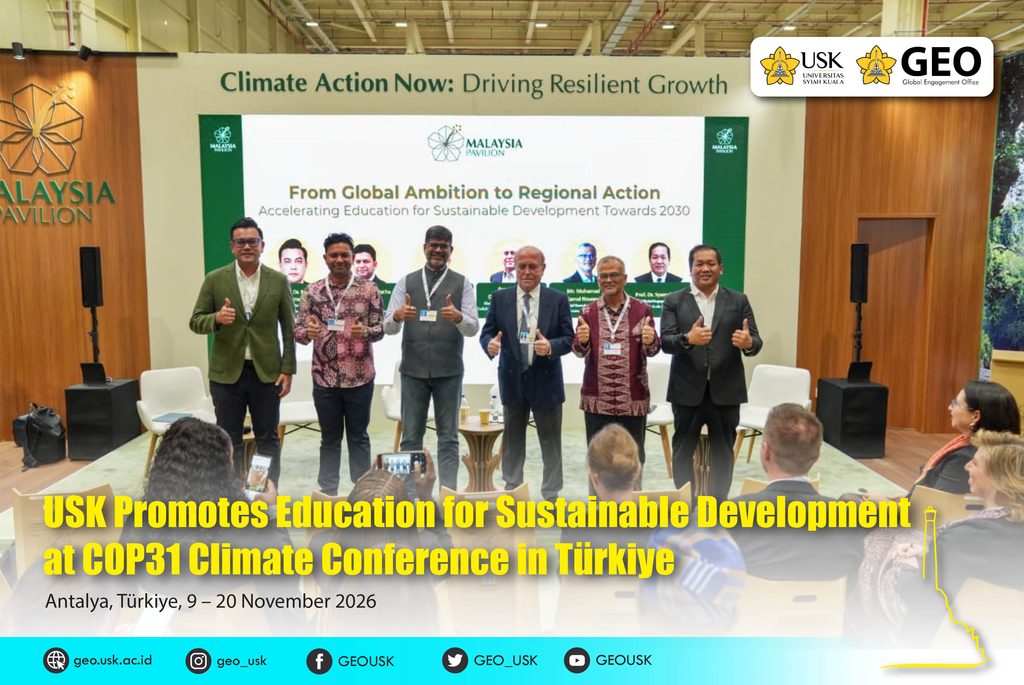
Universitas Syiah Kuala (USK), represented by the Head of Global Engagement Office (GEO), Prof. Dr. Syamsidik, S.T., M.Sc., presented its perspectives on Education for Sustainable Development (ESD) during a High-Level Panel Dialogue titled “From Global Ambition to Regional Action: Accelerating Education for Sustainable Development Towards 2030.” The event was held at the Malaysia Pavilion during the United Nations Climate Change Conference (COP31) in Antalya, Türkiye, on 9–20 November 2026.
The dialogue brought together international leaders and experts to discuss how global commitments can be translated into concrete regional actions, particularly through strengthening education for sustainable development towards the 2030 Agenda.
Prof. Syamsidik joined a panel of distinguished speakers, including Dr. Pramod Kumar Sharma, Senior Director of Education at the Foundation for Environmental Education (FEE); Assoc. Prof. Dr. Abdulkadir Ateş, Chairman of the Board of Directors of the Turkish Environmental Education Foundation (TÜRÇEV); Dr. Balamurugan Ratha Krishnan, Chief Executive of the Green Growth Asia Foundation (GGAF); and Mohamad Kamal Nawawi, Chief Executive Officer of Axiata Foundation. The discussion was moderated by Datuk Ir. Ts. Dr. Mahadi Mohamad, Executive Director of GGAF.
During the discussion, Prof. Syamsidik highlighted key challenges in education, particularly quality, equitable access, and the capacity of regional labour markets to absorb educated graduates across ASEAN. He emphasized that Indonesia still faces significant challenges in addressing these three aspects to ensure that education contributes effectively to sustainable development.
The dialogue connected international experiences, environmental education practices, and regional cooperation through the contributions of several organizations, including FEE, TÜRÇEV, GGAF, and Axiata Foundation. Discussions covered the advancement of ESD through initiatives such as Eco-Schools and Eco-Campus, the sharing of implementation experiences from Malaysia and Türkiye, and the role of digital skills development in empowering younger generations.
The discussion also highlighted the potential contribution of the Indonesia-Malaysia-Thailand Growth Triangle (IMT-GT) University Network (UNINET), which connects higher education institutions across the three countries. Through this regional network, opportunities for knowledge exchange, institutional capacity building, and cross-border academic collaboration can be further strengthened. USK serves as the permanent secretariat of IMT-GT UNINET.
The forum provided an important platform for exchanging ideas on how education can accelerate the implementation of sustainable development while strengthening collaboration among educational institutions, governments, and other stakeholders in addressing environmental challenges and climate change.
USK’s participation in the dialogue also reflects its commitment to the Sustainable Development Goals (SDGs), particularly SDG 4 (Quality Education) through strengthening education for sustainable development; SDG 13 (Climate Action) through raising awareness and building capacity to address climate change; and SDG 17 (Partnerships for the Goals) through international and cross-sectoral collaboration.
Through its involvement in this high-level international dialogue, USK continues to expand its global engagement and strengthen the role of higher education institutions in promoting education and collaboration as essential instruments for achieving sustainable development at both regional and global levels.