
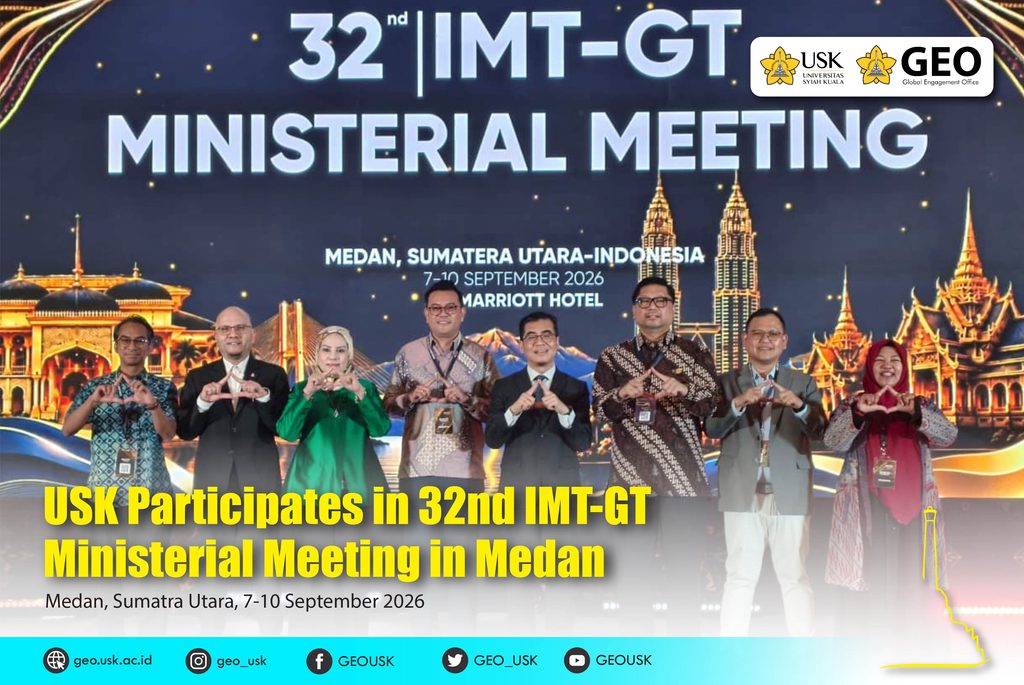
Universitas Syiah Kuala (USK), representing the Indonesia-Malaysia-Thailand Growth Triangle University Network (IMT-GT UNINET), participated in the 32nd Indonesia-Malaysia-Thailand Growth Triangle (IMT-GT) Ministerial Meeting and Related Meetings, held from 7–10 September 2026, at the JW Marriott Hotel in Medan, North Sumatra, Indonesia.
The four-day series of meetings brought together senior government officials, business representatives, academics, and other stakeholders from Indonesia, Malaysia, and Thailand to strengthen subregional cooperation and advance the development agenda of the IMT-GT region.
Among the key figures attending the meetings were Airlangga Hartarto, Coordinating Minister for Economic Affairs of the Republic of Indonesia; Akmal Nasrullah Mohd Nasir, Minister of Economy of Malaysia; and Thanadit Raktabutr, Deputy Minister attached to the Prime Minister’s Office of Thailand.
The meetings also brought together regional leaders, including Bobby Afif Nasution, Governor of North Sumatra; Abu Bakar Hamzah, Chief Minister of Perlis, Malaysia; and Songklod Sawangwong, Governor of Trang Province, Ministry of Interior, Kingdom of Thailand.
Other prominent participants included Hon. Sjahrian Kurnia Ramadhan Harahap, Chairman of the IMT-GT Joint Business Council (JBC); Hon. Professor Datin Dr. Norazida Mohamed, Assistant Vice Chancellor (International) at Universiti Teknologi MARA (UiTM), representing the Chair of IMT-GT UNINET; Hon. Said Zaidansyah, Regional Head and Head of the Asian Development Bank (ADB) Delegation, Regional Cooperation and Integration Unit, Southeast Asia Department; Ms. Intani Nur Kusuma, Senior Officer of the IAI & NDG Division, AEC Department, ASEAN Secretariat; and Mr. Amri Bukhairi Bakhtiar, Director of the Centre for IMT-GT Subregional Cooperation (CIMT).
Representing USK as the IMT-GT UNINET Permanent Secretariat, Vice Rector for Planning, Partnerships, and Business, Dr. Ir. Ramzi Adriman, S.T., M.Sc., IPM., ASEAN.Eng., attended the meetings accompanied by Ria Ervilita, S.Pd., M.Sc., staff member of USK’s Global Engagement Office (GEO).
Strengthening Regional Cooperation and Sustainable Development
The 2026 IMT-GT meetings included the 32nd IMT-GT Ministerial Meeting, 33rd Senior Officials’ Meeting (SOM), and 23rd Chief Ministers’ and Governors’ Forum (CMGF).
The meetings focused on strengthening cooperation in areas including economic growth, connectivity, investment, trade, human resource development, digital transformation, and sustainable regional development.
These priorities are closely aligned with the United Nations Sustainable Development Goals (SDGs), particularly SDG 4: Quality Education, SDG 8: Decent Work and Economic Growth, SDG 9: Industry, Innovation and Infrastructure, SDG 11: Sustainable Cities and Communities, and SDG 17: Partnerships for the Goals.
As a regional university network, IMT-GT UNINET plays an important role in supporting these objectives by connecting higher education institutions across the three countries and promoting collaboration in education, research, innovation, academic mobility, and capacity building.
UNINET Flagship Programs Highlighted
During the 33rd Senior Officials’ Meeting (SOM) and 23rd Chief Ministers’ and Governors’ Forum (CMGF), IMT-GT UNINET presented an update on its activities and achievements throughout 2026.
One of the key initiatives highlighted was the UNINET Flagship Program, which comprises four major activities across the three IMT-GT member countries: Integrated Monitoring Dashboard, Joint Microcredentials, 4IR Business Survey, and Suvarnabhumi Digital Tourism.
The four initiatives reflect the evolving priorities of IMT-GT cooperation, moving beyond physical connectivity toward data-driven development, talent development, digital transformation, business collaboration, and integrated tourism.
The initiatives also contribute to several SDG targets. The Joint Microcredentials initiative supports SDG 4 by promoting flexible and collaborative learning opportunities and strengthening skills development. The 4IR Business Survey contributes to SDG 8 and SDG 9 by supporting business development, innovation, and readiness for the Fourth Industrial Revolution. Meanwhile, Suvarnabhumi Digital Tourism supports innovation and sustainable development in the tourism sector, contributing to SDG 9 and SDG 11.
With 36 member universities across Indonesia, Malaysia, and Thailand, IMT-GT UNINET provides a strategic platform for higher education institutions to contribute to the implementation of the IMT-GT agenda through education, research, innovation, and cross-border collaboration.
The network’s role also directly supports SDG 17, which emphasizes the importance of strong partnerships in achieving sustainable development.
Preparing the Next Phase of IMT-GT Cooperation
The meetings also reviewed developments and activities undertaken by the Centre for IMT-GT Subregional Cooperation (CIMT) and the progress of various working groups throughout 2026.
Delegates reviewed the draft SOM Report and Joint Ministerial Statement, while also discussing preparations for the IMT-GT Implementation Blueprint 2027–2031, which will serve as a strategic framework for subregional cooperation over the coming years.
Discussions further addressed the strengthening of IMT-GT partnerships with key regional and international stakeholders, including the ASEAN Secretariat and the Asian Development Bank (ADB). These partnerships are expected to further enhance connectivity, integration, economic opportunities, and sustainable development across the IMT-GT region.
USK’s Role in Regional Collaboration
According to Dr. Ramzi Adriman, USK’s participation in the IMT-GT meetings is an important step in strengthening international networks and collaboration, particularly with institutions and stakeholders across Indonesia, Malaysia, and Thailand.
“As a higher education institution located in the Sumatra region, USK has a strategic position in supporting regional cooperation in education, research, student mobility, as well as various academic and community-based initiatives,” he said.
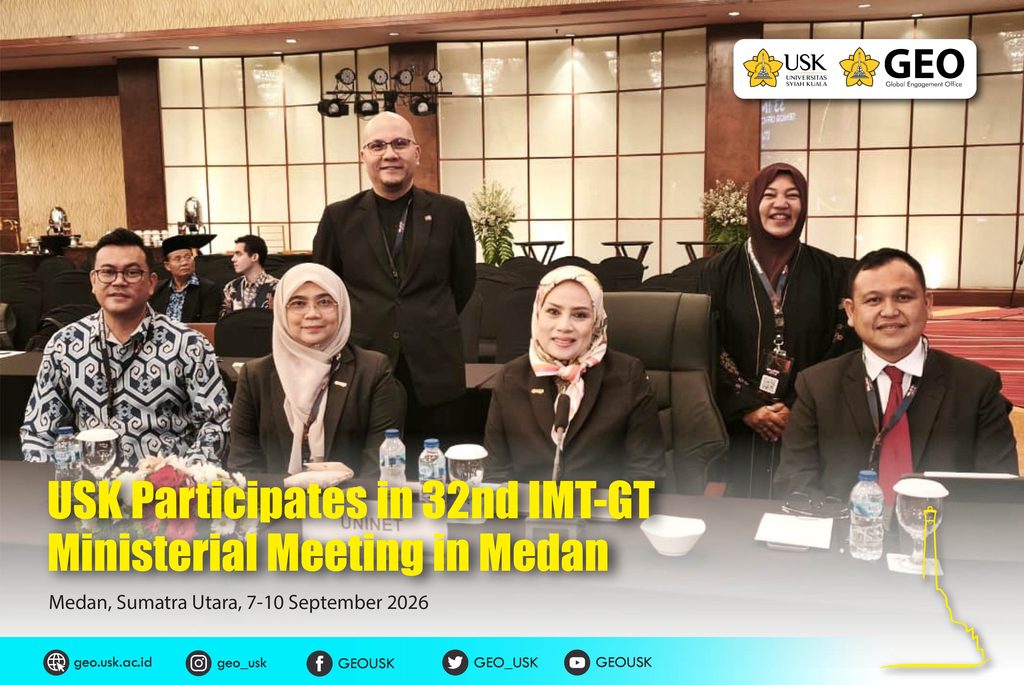
He added that USK’s role as the IMT-GT UNINET Permanent Secretariat provides an opportunity to further strengthen connections among universities and stakeholders across the three countries while supporting the broader development agenda of the region.
USK’s involvement also reflects its commitment to contributing to sustainable development through quality education, research and innovation, human resource development, and international partnerships. These efforts are in line with the SDGs, particularly SDG 4, SDG 8, SDG 9, SDG 11, and SDG 17.
The series of IMT-GT meetings reaffirmed the commitment of the three member countries to strengthening coordination and cooperation toward a region that is increasingly connected, integrated, inclusive, sustainable, and competitive. Through its active participation in regional forums and its role as IMT-GT UNINET Permanent Secretariat, USK continues to expand its contribution to cross-border cooperation and reinforce the role of higher education institutions as key partners in regional development and integration.