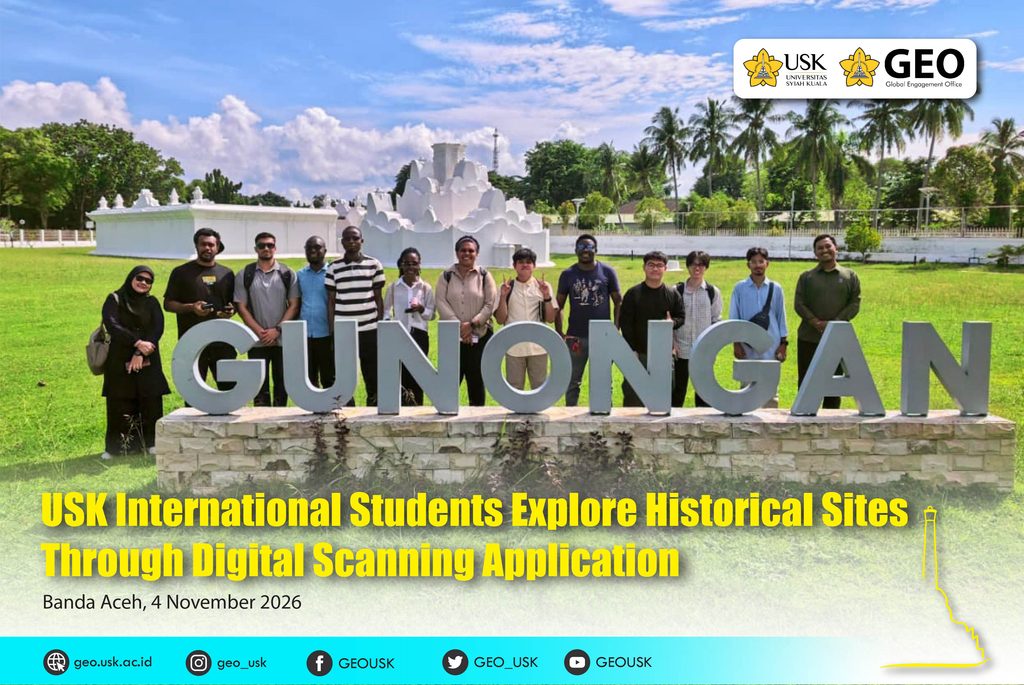

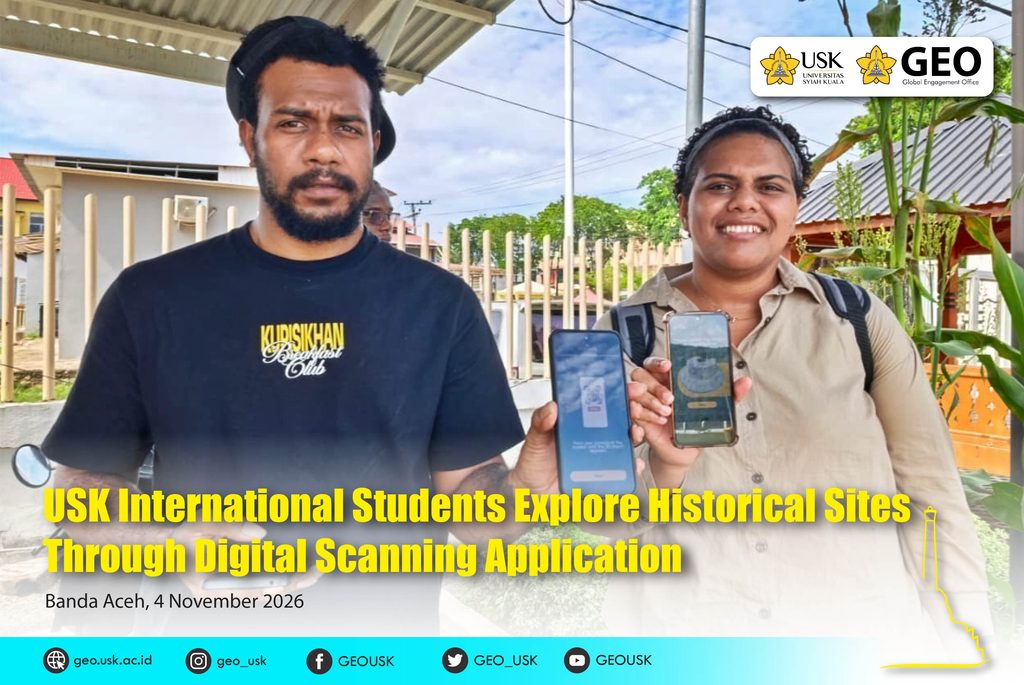
International students enrolled in the Indonesian Language for Foreign Speakers (BIPA) program at Universitas Syiah Kuala (USK), including recipients of the Kemitraan Negara Berkembang (KNB), Darmasiswa, and The Indonesian Aid Scholarship (TIAS) for the 2026/2027 Academic Year, visited Gunongan and Taman Putroe Phang, two historical sites in Banda Aceh, on 4 November 2026.
The KNB scholarship program is managed by Indonesia’s Ministry of Higher Education, Science, and Technology through the Directorate General of Higher Education, Research, and Technology. The Darmasiswa program is organized by the Ministry of Primary and Secondary Education in collaboration with the Ministry of Foreign Affairs. Meanwhile, TIAS is a scholarship program offered by the Government of Indonesia and managed by the Indonesian Agency for International Development (Indonesian AID).
The participating students came from Afghanistan, Zimbabwe, Uganda, Nigeria, Japan, Fiji, Vanuatu, and Pakistan.
The visit was part of the BIPA USK Cultural Class program, organized by the university’s Global Engagement Office (GEO). The program aims to introduce international students to Aceh’s rich history and cultural heritage through direct learning experiences. Beyond exploring historical landmarks, the visit also provided an opportunity for students to experience how digital technology can be used to access information about historical heritage.
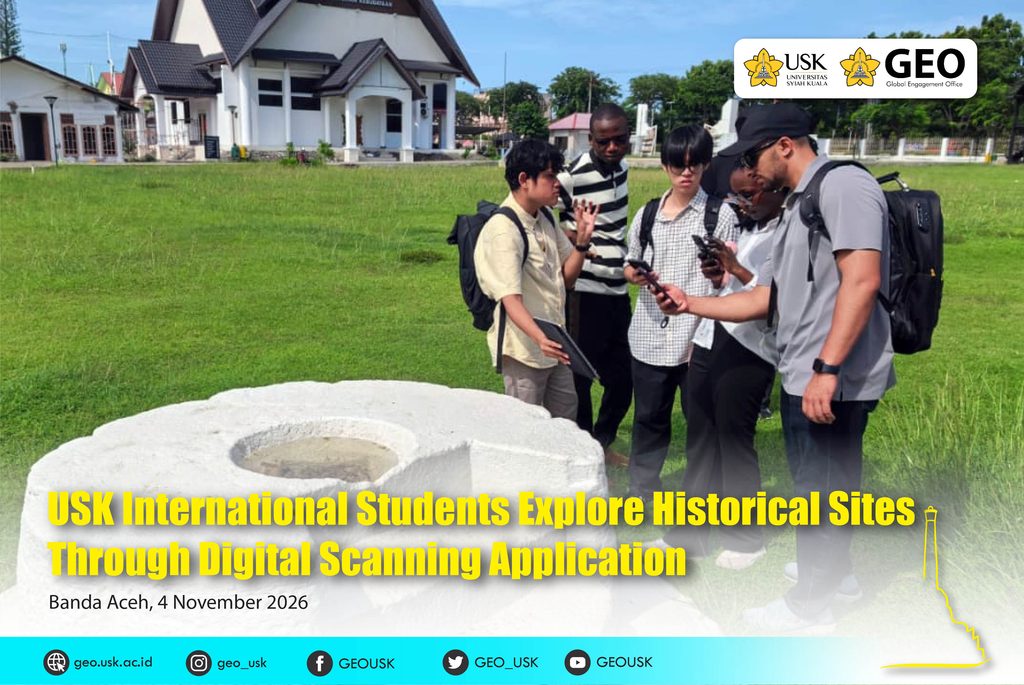
During the visit, the students were introduced to a location-based historical scanning application called Lentera (Lensa Tembus Era). The application was presented by two USK Computer Engineering students from the Faculty of Engineering, Heru Sunanda and M. Syahru Ramadhan, under the supervision of Ir. Rahmad Dawood, S.Kom., M.Sc., IPM., ASEAN.Eng., APEC Er.
Through Lentera, visitors can scan QR codes installed at designated points around the historical sites to access information about their history and background.
Although the application is still under development, its use has offered international students a new way to explore Aceh’s historical heritage by combining educational tourism with digital technology. Rather than simply observing historical landmarks, students can also conveniently access supporting information through their mobile devices.
Through this activity, BIPA USK students are expected to gain a deeper understanding of Aceh’s history, identity, and cultural heritage. The visit also served as a cross-cultural learning experience, allowing international students to become more familiar with the local community and its cultural richness.
The Cultural Class program reflects USK’s commitment to supporting cultural heritage preservation through education, collaboration, and technological innovation. It also demonstrates how historical learning can extend beyond the classroom through interactive, hands-on experiences that embrace developments in the digital era.
This initiative contributes to SDG 4 (Quality Education) by promoting cross-cultural learning, SDG 9 (Industry, Innovation and Infrastructure) through the application of digital technology, and SDG 11 (Sustainable Cities and Communities) by encouraging appreciation and preservation of Aceh’s historical and cultural heritage.